

Behind the Scenes
How It’s Made
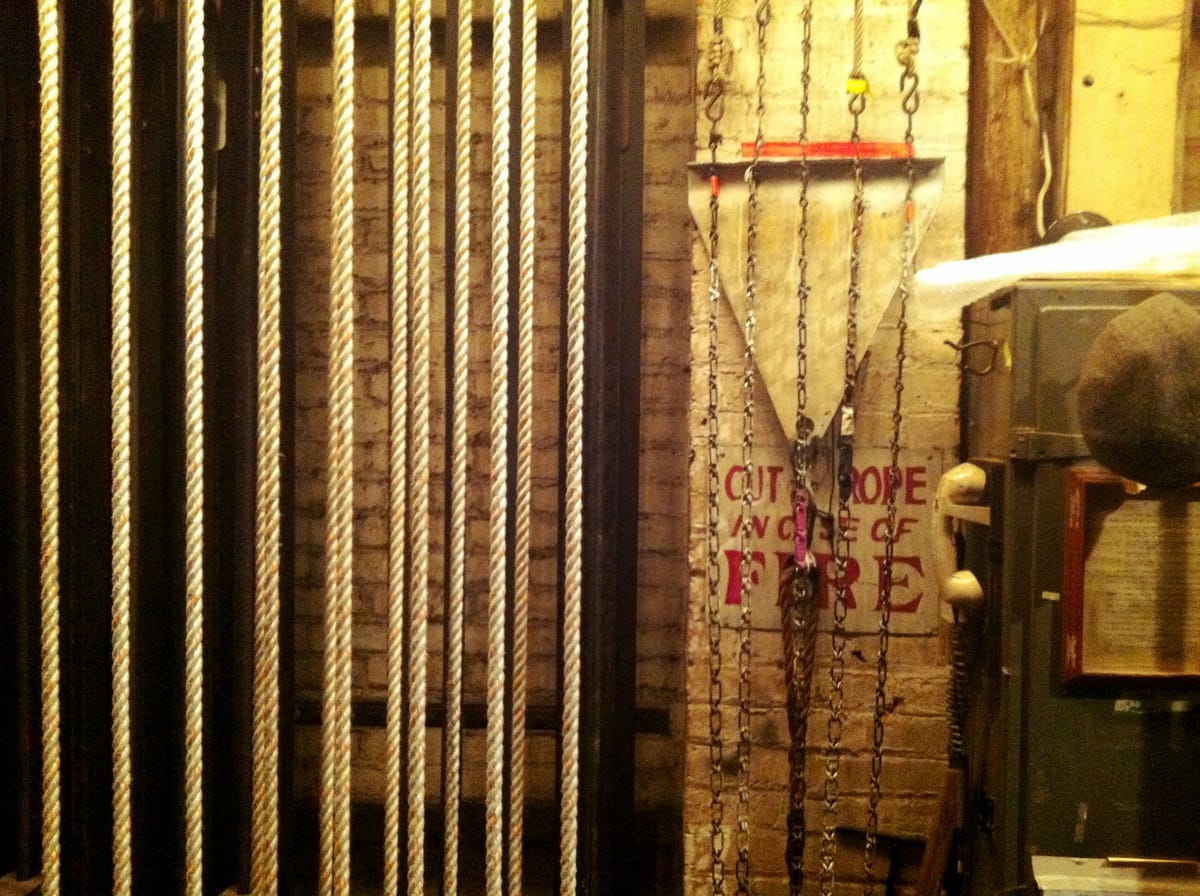
For as long as I can remember remembering, I have always enjoyed anything and everything “behind the scenes.”
Part of my fascination is probably related to my own experience: I have been on stage—literally or figuratively—for nearly half a century: at the piano, in the organ loft, in the orchestra pit, and in various other capacities—paid and unpaid—providing musical, technical, logistical, and other forms of support. A constant across all of these experiences—an important one to me—is the hidden work which goes into everything.
This essay will touch on two related aspects of my own creative process. (Future ones may delve into the broader topic.)
In a recent discussion about writing, a reader of this site shared with me that she found “Punctuation” especially enjoyable—so much so that she read it more than once. She seemed to be moved not only by the plot of the story, but also by the manner in which it was told. My first thought was: “I have done my job, then.” My next was: “That’s interesting; this story is the first work of fiction I have written, as an adult, with anything approaching intentional effects.”
(It should be noted here that, when it comes to writing, I have typically thought of myself as more inclined to poetry; but as a friend observed after one of my attempts at fiction: “Now that you’ve finally figured out you can write fiction—and we know damn well you can write poetry—you just need to find yourself a job writing non-fiction, and you’ll have the trifecta!” [See “A Pilgrim’s Progress” for more on this remark in context.])
What is more interesting to me about “Punctuation” is that it, like “Another Metamorphosis” and “Being and Somethingness” began with a single line, seemingly coming from nowhere. In the case of the latter two works, the line was heard in a dream; in the case of the former, it came to me in a waking state. Awake or asleep, the experience of a line coming to me is similar either way.
In “Another Metamorphosis,” an obvious nod to Kafka’s work, the [original] line in question was “Ted awoke one morning and found himself transformed into a majestic rooster.” In “Being and Somethingness,” the line was “The others had always been clear about how they fought these things—how they fought being on Earth.” “Punctuation” began with “My best friend, Rebecca, never met a comma she didn’t like.” The rest of each story was built around these simple lines.
“In the Grey Disguise of Years”—an allegory—started with two initial phrases, appearing in separate sections, around which the rest of the story was built. They are: “...I moved as if I were somehow mounted upon wheels...” (¶ 7) and “I would have to live my life in reverse.” (¶ 3). (These two lines are also, as it happens, keys to the nature of the allegory.)
This approach can also work with poetry. As examples, each of these poems emanated from a single line:
- “More and More” (“More and more quietly cried / the happy-making people”)
- “An Ode on Cheese” (“Feta is wettah, / but cheddah is bettah!”
- “The Pilgrimage” (“I toiled for twelve years to prepare—”)
- “The Enigma” (“In arrant non-chalance he wends,” [originally, “In total non-chalance he stands”])
- “The Deep” (“When you go deep, into that goodful day–”)
- “Sonnet XX” (“Nominate what shan’t be named:”)
- “sonnet xviii” (“my morning offices complete, / i found him standing, clear and tall;”) [This poem is also notable in that the lines “i found him standing, clear and tall” and “‘your smile is a gift, he said—’” are quotations from speakers who are indirectly related to the subjects of the poem.]
- “Sonnet XIX” (“Baubles; object permanence;”)
- “sonnet xiii” (“sassy sweet and funny proud”)
- “Sonnet XV” (“I made a squirrel for a friend:”)
- “Sonnet XIV” (“when you had set up such a happy howl, / and then you pressed my tears into your face—”)
- “Sonnet XXI” (“Nor time, nor distance, can erase / the sacred imprint of Her face.”)
In most of the poems above, the first line(s) composed is also the first line of the poem; this is my predominant pattern. The last three are exceptions to the rule, where the line composed first appears somewhere after the first line of the poem. (In the case of “Sonnet XXI,” the lines first composed appear as the final couplet; the rest of the poem is constructed toward that end.)
I have also found some success in beginning by writing the title of a work—and, sometimes, the titles of sections within a work. This approach does not always lead directly to the main content of the work; but it seems to guide my thought. (In one sense, this could be thought of as a form of outlining; but I view it as a distinct approach.) “The Linden Letters”—intended to be a series of epistolary works, although only two exist as of this writing—is one example of such a work. (Most of the other titles have not yet been written.) On occasion, I have begun with a title, written the work, then re-titled it. That is, “beginning with the title” can be part of an approach to writing, but one which does not necessarily show up in the finished product.
I invite you to think more about your own creative process—in whatever domain—and in what ways you might incorporate new approaches to your work.



 Support Us
Comments ()