

A Job in Paradise: Part II
An Occurrence on Rainy Lake
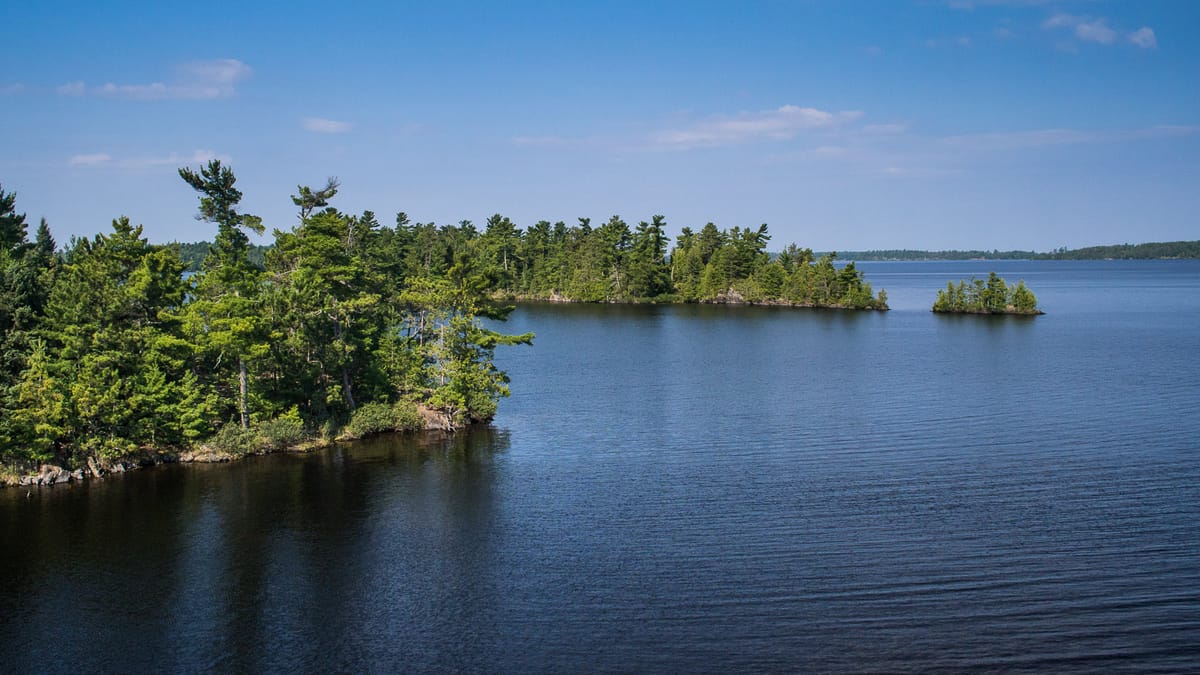
Author’s Note: The subtitle is an homage to “An Occurrence at Owl Creek Bridge,” an 1890 short story by an American Civil War veteran and author from Ohio, Ambrose Bierce. I encourage you to read it, if you have not.
If You Really Want to Hear About It
The first thing you’ll probably want to know is where Rainy Lake was born, and what the Superior Craton of the Canadian Shield is like, and how Lake Agassiz was larger than all of the Great Lakes combined, and all that geological kind of stuff; but for today’s purposes, you can probably make do with reading Part I of my tale.
Hell is Other People1
One of the most annoying aspects of my sojourn at the Kettle Falls Hotel was that most of the other employees were already members of their own little cliques. There was a young couple from Wisconsin—complete with the accents, you betcha—supposedly engaged, who spent most of their time making eyes at each other instead of working; a slick, mustachioed playboy who liked to order others around and spent most of his time attempting to sleep with other staff; and Gary, a grizzled local in his late thirties, given to colourful language and hard work. There were also the concessionaires of the hotel, a married couple in their early forties. He always looked a bit ruddy, quick to anger. She was perpetually annoyed and liked to complain.
Although I did not fully appreciate his qualities at the time, Gary2 was the only one of the Other People whom I did not despise. In fact, I found him quite agreeable.
Getting Around
Gary—who had nearly drowned in Part I when the transmission of the portaging truck failed—became the closest thing I had to a friend that summer. As it turned out, he was a mentor. He was about twice my age at the time, and he seemed to recognise the challenges I faced: dealing with overbearing bosses, long hours, and being the odd one out in the group. In his own rough way, he took me under his wing.
Much of the job involved portaging private boats from one lake to the other, bypassing the Kettle Falls Dam. There were also a number of rowboats, equipped with outboard motors, maintained by the hotel for guests. The boats were kept on Rainy Lake, which is below the falls.
On my rare days off, I liked to borrow one of the boats to explore the lake. Given the size of the lake—345 square miles, the twentieth largest by surface area in the States, with a length of sixty miles and a maximum width of thirty—I generally stayed close to shore. One day, Gary announced he was going to International Falls, asking the group: “Which one of you cocksuckers wants to go on a supply run?” I volunteered.
The trip from the Kettle Falls Hotel to International Falls took about an hour. Gary used the time to explain how to navigate. “You wanna watch careful through this part: these cocksuckers will fuck up your motor, good luck rowing back!” He chuckled. This was as we traversed the American Channel, a narrow passage through tight canyon walls with underwater rock hazards scattered throughout. We arrived in International Falls, loaded the boat with supplies, and returned to the hotel.
A few weeks after this, I took the same trip on my own. I remembered everything Gary had taught me, and made it all the way to International Falls. On the way back, the motor died. I had no idea where I was, only that I was stuck in the middle of the lake near one of the many small bays which line the shoreline. I mounted the oars and began rowing into the bay, thinking I might need to spend the night. After about forty minutes of rowing, another boat came by and towed me back to the hotel.
After that, Gary taught me more about how to operate and troubleshoot the outboard motor, and I made several more successful trips to International Falls and back on my own.
Running out of gas was scary enough. Until you have been alone in the wilderness at this scale, or worse, it is difficult to comprehend the tamed world that we take for granted. The hotel was located on a peninsula with no roads, a boat trip of thirty minutes from the nearest provisions. The part of the lake where I was stranded has no buildings, no electricity—no landmarks beyond the islands, rocks, and trees, assuming they are familiar to you. I was fortunate that day, because of the other boat which had happened by. On another day, I was almost not as lucky.
Near Death on Rainy Lake
As mentioned in passing in Part I, trash from the hotel grounds was carefully secured in a dumpster to avoid attracting bears and other animals. About once a week, the bags were loaded into the trash-boat for towing back to the mainland. Because I was responsible for a good part of the janitorial duties, loading the trash-boat was one of my tasks. Part of this included moving the boat from one side of the dock to the other, to prepare it for towing.
One morning, while I was mopping the bar, one of my bosses stopped by. “You better drop that mop right now, you’re going on a little trip!” He was fuming. “You didn’t tie up the fuckin’ trash-boat last night...we can’t afford another one! The dam probably chewed it up, but you better go look for it. Maybe you’ll get lucky! Go!”
Of course I had tied up the trash-boat; but apparently not properly. I left my bucket and mop, ran down to the lower dock, and started off in one of the boats. This trip involved navigating back toward the area below the dam. After about fifteen minutes, I found the trash-boat floating near one of the islands. It was half-submerged, so I bailed out some of the water. Then I tied a line to its bow, with the other end tied to my stern; I gunned the engine.
This was a bad decision. Instead of towing the trash-boat, the stern of my boat instead began filling up with water. If I did not stop it quickly, it would sink. The water was cold and deep, and I did not feel like drowning that day. I untied the line just in time, then bailed the water out of my boat. Meanwhile, both boats had drifted near a small dock. I nudged the trash-boat toward the dock and bailed out more water so I could pull the bow over the edge. I was then able to tow the trash-boat onto the dock enough to turn it over and empty out the rest of the water. After that, I towed the trash-boat back to the main dock so we could portage it back to the upper lake, above the dam.
The boss was surprised, but happy, for once.
A Failed Relationship
The Trash-Boat Over the Dam incident, as I have come to think of it, was but one of a series of mishaps and misunderstandings which transpired between me and my bosses at the hotel. It has now been so many years ago that I do not remember all the details. Most likely, it was as much owing to my own impetuosity as anything, although at the time I remember thinking it was 100% my bosses’ fault. Whatever the case, I decided to quit the hotel job early, taking a short-lived job as a church organist in Cloquet, Minnesota, as you may remember reading about in My Flash in a Flophouse. (I also had a job in Duluth, for exactly one day, as a vacuum-cleaner salesman. That is another story, for another day—perhaps I will tell you when you are older.)
Footnotes
- Jeff Kantor, a native of International Falls, took many photographs of the region he knew and loved.
- See No Exit, by Jean-Paul Sartre.
- Gary, requiescat in pace, was an interesting character.


 Support Us

Comments ()