

Interesting Times
(It is not, after all, a traditional Chinese curse—but it ought to be)
Editor’s Note: As noted on our For Authors page, we do not typically publish political pieces. However, sometimes, we do.
Things Fall Apart
Sometime around 2015 or so, it became apparent to me that we live in “interesting times;”0 we still do. In fact—to borrow from Churchill—I believe “...this is not the end. It is not even the beginning of the end. But it is, perhaps, the end of the beginning.”
One of the reasons that Donald Trump, Elon Musk, Scott Bessent, Stephen Miller, and others of like mind—including their non-U.S. counterparts—are rising is that useless administrators, often opposed to fundamental norms of Western civilisation, have been allowed to run amok in society for far too long. Three obvious and recent examples of this include the predominant institutional treatment of Covid, climate change, and so-called transgenderism. There are many others, some occurring over a longer period, including, notably, “the long march through the institutions.” To apply—metaphorically—a phrase from Bukowski: “the trouble with these people is that their cities have never been bombed and their mothers have never been told to shut up.”1 Perhaps you do not like the tone of this phrase; but it is much like the saying, falsely attributed to Edmund Burke: “the only thing necessary for the triumph of evil is for good men to do nothing.”2
Post-Covid, and post-Obama—and I count the Biden Puppet Administration as the Third Obama Administration—many people have begun to reclaim their voices. It is encouraging to see. This phenomenon is perhaps most clearly evident on X and Substack, but also on certain other online platforms, not to mention in some sectors of meatspace.
Some may argue for “decorum”—that we need to return to a more “civil” discourse in the sociopolitical and cultural dialogue. With some exceptions, I disagree. The more direct and sometimes confrontational styles we increasingly see today—Trump, Musk, Bessent, and Miller being good examples thereof, each in his own way—is a natural reaction of years of our collectively having kowtowed to ignorant and cocksure HR and schoolmarm types—sometimes also referred to as AWFULs.3
That bollocks is coming to an end; common sense is making a comeback. The harsher language is a reaction to the garbage being forcibly shoved down our throats. To push back on stupid ideas, one needs to speak frankly, even if—and sometimes because—it offends delicate snowflakes and the wilfully misinformed.4 Perhaps more important: when leaders push back on stupidity, people follow. This aspect is critical to preserving Western Civilisation; preserving Western Civilisation is necessary, because it is superior to other civilisations.
(It is instructive that even some more left-leaning folks, many of whom dislike Trump’s antics, not to mention his policies, have come to see a reaction of this kind as inevitable. Somewhat related to this, you may enjoy learning more about Trump as a counter-revolutionary, an idea explored by historian Victor Davis Hanson.)
All of that being said—as I have often stated elsewhere—I also think the time is ripe for proactively building coalitions and restoring community, with the seemingly tiny group of people who are capable and willing. Doing so requires engaging one’s sociopolitical rivals to find common ground; but we still need to put some people in their place, when and where appropriate. As uncomfortable as it can be, this means speaking up, more truthfully and more bluntly than we have given ourselves permission to do in the past.
The Centre Cannot Hold
On a somewhat related note, I recently stumbled upon this post:
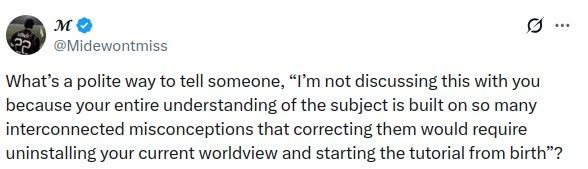
This accurately describes the experience of attempting to discuss any serious topic with certain people. Many are playing word games, sometimes unaware they are doing so. Others are so ignorant of foundational facts, history, etc., that discussions are a waste of effort.
Some people also become angry or afraid when you tell the truth. You cannot reason with them; often, they want you to lie, too. “Truth”—while it can have absolute as well as relative manifestations—is not difficult to define. For everyday purposes, it is simply what can be verified according to a shared set of meaning. It only seems more difficult today, because some people have decided to manipulate previously shared sets of meaning, without admitting to having done so. After unilaterally changing the meanings of words and ideas, they then pretend that their preferred meanings were always the standard.
As one example, the Second Amendment of the United States Constitution is clear in its meanings as they were commonly understood at the time of its writing: the government may not restrict the people’s innate right to own and carry weapons, because it’s important for the people to be able to defend themselves, most notably against the government, if necessary. Some people have decided that militia and regulated mean something like “people can have weapons only if they have been permitted by the government to belong to a government-sponsored military group.” This is, roughly, the very opposite of its meaning.
Granted, the wording of the Second Amendment is perhaps somewhat complex, in that one must read and understand other contemporaneous documents, in context, to grasp the meanings of the text; but that is no excuse for wilfully misinterpreting it.
In contrast, some attempts at unilateral redefinition are more obvious. As examples: adherents of transgenderism and other ideologies which are incoherent and/or depart radically from reality—so-called critical theory (especially as applied to race and in post-Second Wave feminism), communism, etc.—similarly distort the commonly known meanings of various words, to the point that they become useless: woman, man, racism, sexism, far-right, gender, Nazi, and rape are all good examples.
When it becomes clear to you that someone is playing such games, their arguments may typically be rejected without explanation. That said, it is simultaneously troubling that so many people are easily fooled by games of semantics, such that they may believe there is “no truth,” rather only “my truth.” (Perhaps more troubling still: many of these people vote.)
Epilogue
Some weeks ago, I had a casual conversation with a stranger who was passing through the town where I live. A few of us had been hanging out in a local drinking establishment; at one point, the stranger declared: “I’m a Republican, and I love America!” Aghast at this hate speech—and because I live in a neighbourhood which includes a number of rabid commie types—I leaned over and said, helpfully, “careful, you might get in trouble saying that in these parts.” A bit later, I told her that we have a “non-binary” “councilperson” in our fair city, to which she immediately retorted “my condolences,” which is the only correct response.6 Immediately after that, a group of dapper, well-spoken, and racially diverse far-right Republican supremacists stormed in the bar, yelling “this is MAGA country!” and beat us up for not being bigoted enough.7
Footnotes &c.
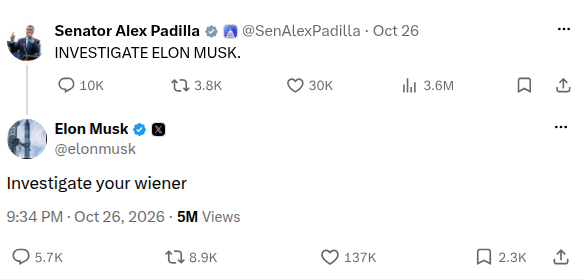
*The feature image is a screenshot of an X post from the ignoble Senator Alex “José” Padilla, with a well-deserved reply from Elon Musk.
The section titles are borrowed from “The Second Coming,” by William Butler Yeats.
- “may you live in interesting times” (See also: 寧為太平犬,不做亂世人.)
- From “Trouble,” a poem by Charles Bukowski.
- Apparently, the closest known phrase is from an 1867 inaugural address by John Stuart Mill, who said: “Bad men need nothing more to compass their ends, than that good men should look on and do nothing.”
- AWFUL is an acronym for Affluent White Female Urban Liberal. If you are not familiar with the term, there is plenty to be found online. This is one decent short introduction. More broadly (pun not intended), the term does not necessarily refer only to women, but to anyone with a particular sociopolitical view. Scott Greer originally popularised the term in this article.
- Not for nothing, Greek gives us the word amathia, (ἀμαθία), meaning “wilful ignorance or intelligent stupidity.” It comes from the prefix a- (not or without) combined with mathia (relating to learning or knowledge). It is an active, conscious refusal to learn, listen, or change direction. In contrast, agnoia (αγωνία) is a basic lack of information or exposure to knowledge. Author Nassim Nicholas Taleb touches on related ideas when he describes the “Intellectual Yet Idiot” (IYI), typically a subset of academia and politics: credentialed, risk-averse professionals who dictate societal rules without facing the consequences of their mistakes.
- Oddly enough, the author of this post considers himself to be “non-binary,” yet makes a perfectly cogent point nonetheless. This is an interesting example of how some people are very good at compartmentalising—in this instance, being able to think clearly about one topic while indulging in disordered, fantastical “thinking” in another.
- There is no such thing as being “non-binary,” just as there is no such thing as being “transgender.” There are also no unicorns; some people believe themselves to be Napoleon, or Jesus. (Source; see also: Hitchens’s razor.)
- This is a joke. I am making fun of racist agitator and general buffoon Jussie Smollett and the many people who swallowed his ridiculous, uh, fairy story. As it turns out, most so-called “hate crimes” today are hoaxes. So are many, if not most, so-called “news” reports.



 Support Us
Comments ()