

Sonnet XX
As who by being poisoned doth poison know

exit blue, or iris green;
contain it for the thing contained.
You touched me—and what did it mean?
Conscience is already caught:
the play’s the thing—and, as You will—
You said Your lines, no “is” nor “ought.”
You took it—and You keep it still!
Consecrate what You have claimed:
enter left, aquamarine;
frame it as the thing reframed.
You kiss me—I know what You’ve seen.
Hold it fast, and take me down:
(King me, and You’ll wear the crown.)
Editor’s Note
“Sonnet XX” takes a cue—in both form and content—from some of Sir Philip Sidney’s more experimental sonnets, of which the first sonnet of his “Astrophel and Stella” (typically spelled in modern editions as “Astrophil and Stella”) is one example. Its rhyme scheme, ABAB CDCD ABAB EE—while differing from that of “Astrophel” specifically—is characteristic of Sidney’s variations on the Shakespearean (English), Spenserian, and other traditional sonnet forms.
The return of the A/B rhymes in the third quatrain may invoke a feeling of repetition, return, or even obsession. These effects can be well-suited to themes of unrequited (or circuitous) love, or of the struggle of Carl Jung’s so-called Nachtmeerfahrt, or Night Sea Journey—a concept peripherally related to the more popularly known “dark night of the soul.” The final EE couplet provides a strong, epigrammatic close, serving as the “turn” (volta) of the poem—typical of English sonnets—delivering a pithy conclusion illustrating the narrator’s self-awareness.
“Sonnet XX” also experiments with meter, using lines containing a combination of acephalous (headless) and complete iambic tetrameter, instead of the iambic pentameter more typical of such sonnets. (The headless lines could also be interpreted by some readers as catalectic trochaic tetrameter, but the editor does not hear it that way; still, it is easy enough to listen from either perspective.)
The pattern of headless and complete lines in the poem follows the narrator’s journey through the subject matter:
- In the first quatrain, the first two lines begin with stressed (strong) syllables—those lines are headless—implying decisive action. The last two lines begin with unstressed (weak) syllables—those lines are complete—suggesting questioning and uncertainty.
- In the second quatrain, this pattern shifts to strong, weak, weak, weak—perhaps still implying doubt, while also suggesting movement toward action.
- In the final quatrain, and in the closing couplet, all of the lines—except for the last line of the quatrain, invoking a fleeting moment of vulnerability—have become strong (headless).
This shifting pattern mirrors the progress of the narrator’s thoughts, feelings, and actions—including resignation, hope, anger, and supplication, building up to a series of commands and culminating in a final exhortation. (The reader may also be interested to compare the effect of headless and catalectic feet by reading “Sonnet XIX.”)
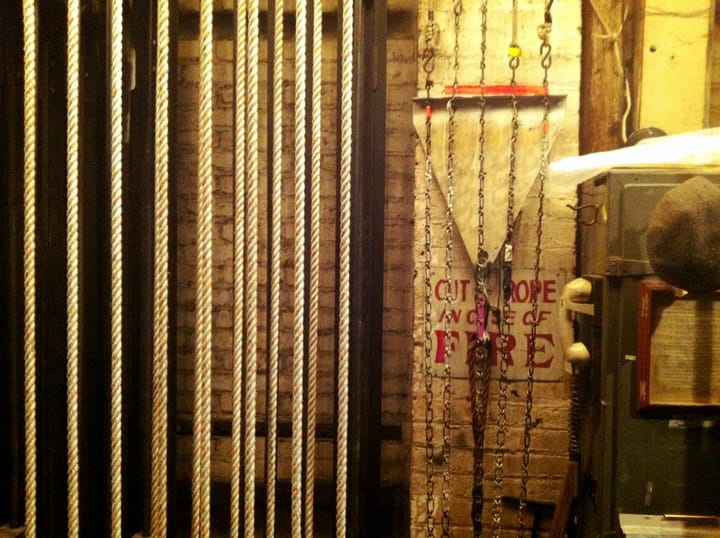
In one sense, the poem takes an enigmatic approach to its material; in another, it is a relatively straightforward telling of elements of the narrator’s inner experience. It employs a number of devices, including alliteration, paronomasia (pun), double entendre, sarcasm, symbolism, allusion, parallelism, and indirect repetition. It even adds a bit of outright hubris and grandiloquence—meant to undercut the narrator in a self-deprecating and self-effacing way—even while he moves steadily toward a solid conclusion of the matter. (Even the title itself, “Sonnet XX,” includes a hidden meaning, as does the artwork. These are left as exercises for the reader.)
The subtitle of the piece as published on The Kermudgeon is taken from Sonnet 16 of “Astrophel and Stella.” Understood in context, the full couplet is one of the more powerful—and poignant—in Elizabethan poetry:
As who by being poisoned doth poison know.
Further Reading
- Sir Philip Sidney, “Astrophel and Stella”
- Iris green pigment
- E. E. Cummings, “[All in green went my love riding]”
- James Thurber, “Here Lies Miss Groby”
- William Shakespeare, Hamlet, Act 2, Scene 2
- David Hume’s is-ought problem
- Antoine de Saint-Exupéry, Le Petit Prince
- Theodore Roethke, “I Knew a Woman”


 Support Us
Comments ()