

Les Tombeaux
To them whom Thou lovest
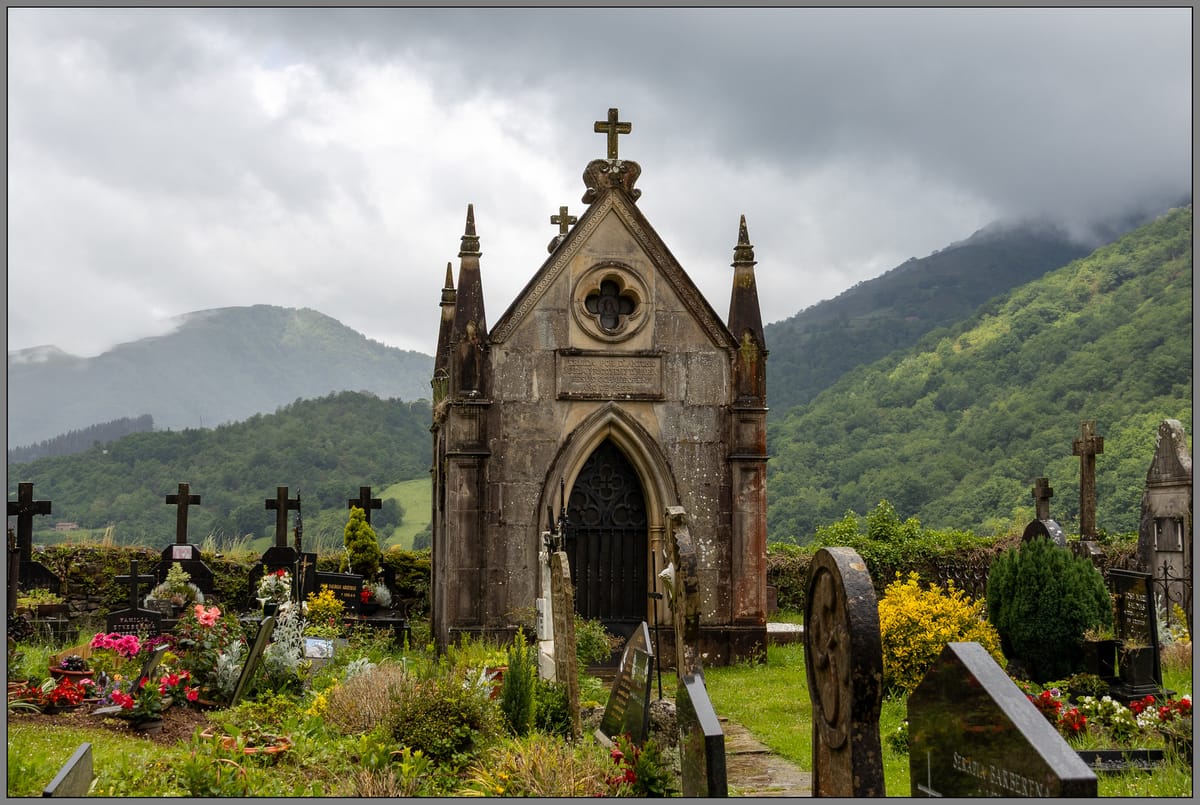
A tombeau, derived from the French word for tombstone, refers to a musical composition—or in some contexts, a poem—written to commemorate the death of a notable person. It is sometimes used more broadly to refer to any work created in memory of anyone—“notable” or not.
While a tombeau, properly speaking, is specifically created for the purpose of honouring someone who has died, I see two other types of works as similar:0
- a work, created in contemplation of a particular person (or situation), which, upon later reflection, appears to more closely capture the essence of someone else (thus not strictly a tombeau in that it was not originally written for the person whom it commemorates); or
- a work created to preserve the memory of a currently-living person—often, in part, in solemn contemplation of their eventual demise.
(I find the second case more fascinating.)
Allow me to share some examples of such works with you, Dear Reader.
In Maurice Duruflé’s (1902–1986) Prélude et Fugue sur le nom d’Alain, the measures leading up to and subsequently quoting Jehan Alain’s (1911–1940) own Litanies are more sublime to me every time I listen.1
While Duruflé’s music sings for itself, I believe that an awareness of its purpose adds to the affect it evokes. This seems all the more so, if one knows something of Alain himself—in particular, of his Litanies,2 [warning: this recording is LOUD] and of the sad-but-heroic circumstances of his death.
Composer Maurice Ravel (1875–1937) lost a number of friends in what was then known as the Great War. He composed Le Tombeau de Couperin to remember six of those friends: each movement of the piece represents a specific person. In addition to the main purpose of memorialising his friends, the piece pays homage not only to composer François Couperin but also to certain aspects of French keyboard music.
There exist many more examples; two other pieces I love are Cantus in Memoriam Benjamin Britten, by Arvo Pärt (1935–) and Edward Elgar’s (1857–1934) Symphony No. 2, dedicated to the memory of King Edward VII.
Does the knowledge that a piece of music was composed—or a poem written—as a tribute to someone contribute to our enjoyment when listening to or reading it? Alternatively, did the composer or poet put something more into the work itself than he might have done otherwise? Is it a bit of both?
To my ear, there is something more poignant in the pieces composed for Alain, and for Ravel’s friends, than in those composed for Britten and for the king. Perhaps this is owing to the senselessness of the loss in the former two cases. Regardless, all such works have always struck me as particularly beautiful and important.
I have also made attempts at a tombeau or two.
The first, Le Tombeau Phrygien,3 was composed in memory of a family member. I had the opportunity to share it with her surviving husband, who, after expressing that he was quite moved by the music, told me that Ravel’s Le Tombeau de Couperin had always been one of his favourites! When he subsequently died some two years later, I dedicated to his memory an essay I had written some thirty years before.4 (The essay is an example of a piece which is not, strictly speaking, a tombeau, in that it was not originally created for a commemorative purpose.)
My second tombeau was Sonnet XIX, written in memory of a friend.
Moving on to other works which are not strictly tombeaux, I have written a few others in contemplation of those who have left us:
- Het Egyptische, et al.
- Ruminations on Death
- Sonnet XIV (one of the two dedicatees is still among the living, so I suppose that makes it a demi-tombeau)
...and a few more in contemplation of those who are still with us:
- Le Rêve
- Py[ai]ku
- The Deep
- sonnet xiii
- Sonnet XV
- sonnet xviii
- The Enigma
- Punctuation
- The Long Game
- Another Metamorphosis
- How I Swallowed My Heart
- In the Grey Disguise of Years
- The First Epistle to the Terentians
...and of course the so-called Spider Stories and related poems, whose protagonists are not only alive and well in real life, they are still writing their stories:
I invite you to consider exploring these and other works of music and literature which were written to commemorate someone’s life. Perhaps you will also create your own.
Endnotes
- One may delve further into the taxonomy of such matters; the elegy is a related form; both elegy and tombeau are sometimes used more loosely than the original, stricter meanings require.
- The quoting of Alain begins at approximately 1:15.
- The recording is of his sister, Marie-Claire Alain.
- Phrygien is the French form of Phrygian, which describes a musical mode (essentially, a scale), used in church chants during the mediæval era.
- The essay in question was one I knew he would have appreciated, in that it is about the use and misuse of language. My fondest memories of him include hearing his war stories about writing and discussing some of our shared musical favourites.
- The dek is taken from John Donne’s “A Litany.”


 Support Us
Comments ()