

The Linden Letters: 1
“You become responsible, forever, for what you have tamed.”
My Dear Phoebe,
I enjoyed the meanderings in your last letter as to whether the people we today call “Native Americans” were indeed the original inhabitants of North America. Fascinating! I have long believed we may never know the answer to this mystery. Regardless, it does not change much about the here and now, nor the history of your people—at least, of that half of your ancestry.
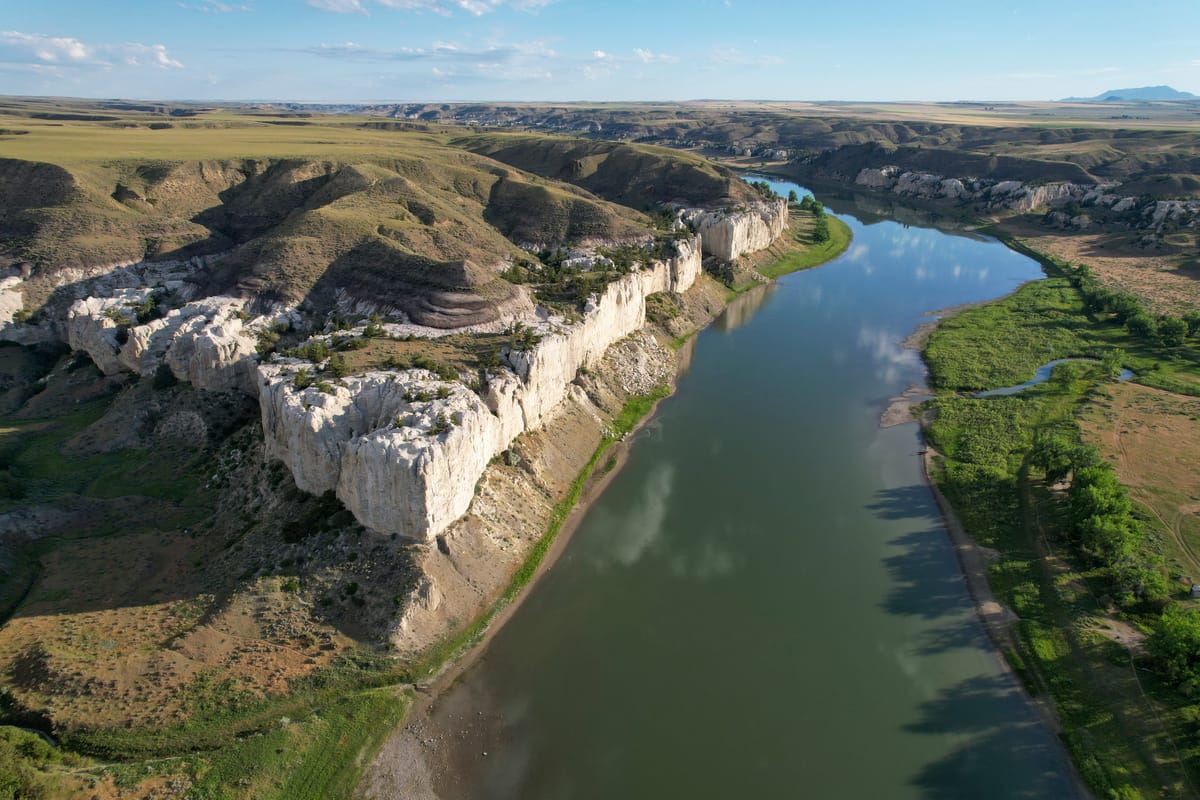
You may recall my partly-in-jest rant about The Ocean—The One World Ocean® (TOTOWO), and how everyone is crazy for pretending there are really multiple oceans. (That reminds me, I need to write an essay about how I came up with that idea.) Well, it is time to admit I feel that way about the Great Missouri, too—probably even more strongly than I do about TOTOWO. What we call the Mississippi River was misnamed: the Missouri is longer, carries a greater volume of water, and drains a larger basin. The so-called “Mississippi River” should properly be called the Great Missouri River.
Naturally, I blame one of your people’s rival tribes—the Ojibwe, specificially—for this misadventure, given that they, along with the cheese-loving French, were responsible for mapping the “Mississippi,” prior to Lewis and Clark, et al., coming on the scene to map the real river. (Mais oui, mon petit chou, je sais aussi que tu as des ancêtres français. Mais ne nous laissons pas détourner du sujet.) Besides, the mappers of the Mississippi simply did not know the extent of the Great Missouri at that time, and so I extend some little grace to them, in much the same way as I do to you for your many peccadilloes. (Marquette and Jolliet notwithstanding, I am far more intrigued by the later work of Nicollet and the Ojibwe.)
In my youth and early adulthood, I spent many hours exploring various tributaries of [what I consider to be—and I am unanimous in this, Miss Brahms] the Great Missouri. I have also been fortunate enough to live most of my life thus far near the St. Lawrence Divide, which means it has been approximately as easy for me to navigate the waters which flow north to the Bay as those which terminate in (well, technically, some nearly one hundred miles after) the humid hellhole known as New Orleans. (Remind me to tell you about the time I disembarked from an airship there. It was absolutely horrid; I shall never return.) Some people may say, “water is water.” They could not be more wrong: it is like the difference between B-flat major and F-sharp minor—and probably as difficult to explain.
This reminds me: I believe you remember some of my tales from Up North. But I don’t think I ever shared with you the little snippet of a poem I found in my father’s notes, after he died; I have long thought of finishing it, like some kind of Süssmayr to his Mozart. Here it is—I believe North was just his working title, but who knows with him:
Our mother says we come from farther north,
From glassy lakes, amid the boreal wood,
From out of which our ancestors came forth,
And where the monuments to them once stood.
That stanza reminds me of your people, when it is not busy reminding me of my own. I confess it brings a tear to my eye every time.
I digress. The main point is that, regardless of whether the “Native Americans” were the first human inhabitants of our fair land, it is certainly obvious from your “pluck” (as I like to call it—probably owing to my intemperate devotion—in order to gloss over your shortcomings) that you have not betrayed the fierce spirit of your Beringian ancestors. Speaking of forebears, it would be instructive to trace the French side of your family, to see whether—as I strongly suspect based on your disposition alone—you are more closely related to Nicolet (the courier des bois) or to the Nicollet I mentioned earlier. But that is a project for another day!
As always, you will overlook my little sarcasms: they are offered only in the spirit of all the ways that I love you.
Meanwhile, “you of my heart, send me a little word.” (From that poem we were discussing recently, remember?)
I trust the other work continues apace.
Yours affectionately,
Ronan
Editor’s Notes & Further Reading
- The dek is taken from Chapter 21 of The Little Prince, by Antoine de Saint-Exupéry, here citing the 1943 translation by Katherine Woods.
- This letter, reproduced verbatim, is one of the many Ronan wrote to Phoebe during her time abroad. Sadly, with a few exceptions, most of hers to Ronan were lost. You may also be interested in the related Spider Stories & Poems.
- We have chosen to publish this particular letter today to commemorate Bastille Day, which (as you know) is tomorrow.
- There is much to be read about theories which suggest the “Native Americans” were not the first to inhabit the New World.
- The various explorations and mappings of the rivers of the New World make for fascinating reading!
- The author of this week’s story, TomK, has long taken a special interest in epistolary fiction, of which there exist a number of excellent examples. (We are advised that one of our readers is partial to The Screwtape Letters, by C. S. Lewis.)
- The E. E. Cummings sonnet “it may not always be so”, mentioned toward the end of the letter, is worth a read. (As you read it, recall that it was written in 1917.)


 Support Us

Comments ()