

A Job in Paradise: Part I
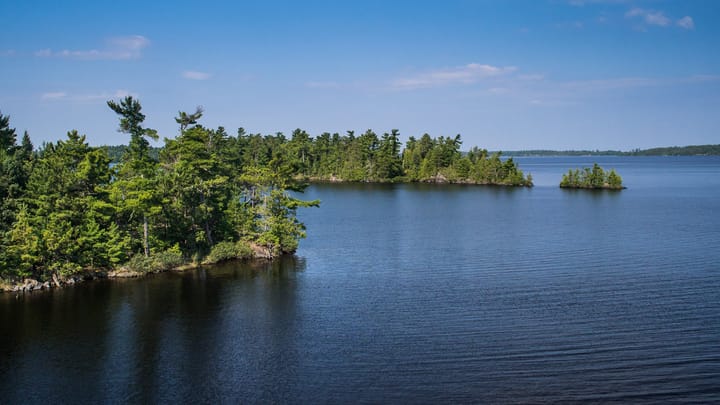
An Occurrence on Namakan Lake

Author’s Note: The subtitle is an homage to “An Occurrence at Owl Creek Bridge,” an 1890 short story by an American Civil War veteran and author from Ohio, Ambrose Bierce. I encourage you to read it, if you have not.
Finding Myself
In the summer following my sophomore year, I checked a book out of the university library: Jobs in Paradise.1 This book was a resource for anyone wanting to find a so-called “dream job”—most of them in scenic locations—tropical resorts, national parks, ski areas, cruise lines, etc.
It is funny to look back on now; at the time, finding such a job for the summer seemed like a Good Idea. Having just spent the previous two summers—the one after graduating from high school and the one after freshman year at university—working as a counsellor at two summer camps, it was time for something new.
Dear Reader, you must recall that the Internet as we know it today did not exist. More accurately, it existed, but it was not useful for researching jobs, travel, or anything of the sort.2 Thus, I also spent time looking through other books about the pros and cons of working on a cruise ship, at a ski resort, etc.
After much research, I decided to apply for several jobs. I do not remember now what all of them were; the one for which I was hired was as a hotel worker—exact position unspecified—at the Kettle Falls Hotel, in Voyageurs National Park.3
Getting There
Unlike most Americans at the time, I had not obtained my driver’s license until I was already in university; I believe it was sometime during my freshman or sophomore year. In any case, I did not have an automobile, nor the funds to fly to my summer job: I took a Greyhound bus, instead. This involved travelling from Central Ohio to Orr, Minnesota. I can confirm that this part of the trip took much longer than it should have—a point which will become relevant presently.
After arriving in Orr—population 265 (214, today)—it was another forty-five minutes by taxi (this was before ride-sharing services) to the Ash River Visitor Center, in Voyageurs National Park. Orr itself was remote enough; the Ash River Visitor Center is in the middle of nowhere. From the visitor center, a ferry left twice a day for the hotel—a trip of thirty minutes; there are no roads, so a boat or float plane is, to this day, the only way in or out.
As it happens, I arrived at the Ash River Visitor Center after the last ferry had departed for the day. I called the hotel using a payphone, as mobile phones were not yet common. They informed me I would have to wait until morning for the next ferry.
Night was falling. The visitor center was closed for the day. I had no way to get anywhere, with very little money, in a forlorn place with no hotels, no residences, nothing. Then, I noticed a nearby marina, with several boats still in dry dock from the off-season. I carefully approached a sloop, found a way in, and made my way to the forward v-berth, where I spent a somewhat unpleasant night with no blankets.4
The next morning, the hotel ferry arrived, and I was soon at the historic Kettle Falls Hotel.
Making it Mine
The concessionaires of the hotel (more on this later) were a married couple in their early forties. As bosses, they were fair enough, albeit somewhat disorganised. The division of work was fluid: while some positions were assigned, many tasks were left up for grabs. I found myself gravitating toward cleaning work, and no one seemed to mind.
My daily routine consisted of cleaning all the public areas of the hotel, which included a bar with a famously tilting floor—a challenge to keep the bucket from tipping over while mopping it! After the public areas were vacuumed, mopped, and tidied, I moved on to the guest rooms. Beds had to be stripped and remade, towels replaced, and bathroom items restocked. Trash bins had to be emptied and taken outside to a dumpster, the contents of which were periodically towed back in a trash-boat to the mainland. The dumpster was carefully secured to avoid attracting one of the 150 black bears which live in the park: I saw several during my stay.
After cleaning tasks, I moved on to whatever else needed to be done. Some days, this meant waiting tables for lunch or dinner, taking reservations, performing sous chef duties, or operating the commercial dishwasher. Other days, it meant working on outfitting several recently constructed cabins, or helping with the portaging of boats from Namakan Lake to Rainy Lake in order to bypass the dam at Kettle Falls.5
Cutting Up
The hotel, built between 1910 and 1913, is located on the edge of the Kabetogama Peninsula—one of the few places where Canada is south of the United States. It is prime fishing, kayaking, canoeing, and hiking territory. It is also an excellent location for spotting wildlife: timber wolves, black bears, moose, beavers, river otters, bald eagles, ospreys, loons, white pelicans, grouse, lynx, white-tailed deer, snowshoe hare, and red squirrels—not to mention over one hundred known species of songbirds. Aquatic life (and fishing) includes walleye, northern pike, smallmouth bass, crappie, and lake sturgeon.
The concession contract for operating the hotel and its grounds had recently changed hands, and the new concessionaires wanted to take advantage of several newly constructed cabins, built by the National Park Service, which had never been occupied.
I was given the task of installing bunk beds—two or three in each cabin. This involved bolting the parts together, cutting platform bases to size from sheets of 4′×8′ waferboard, screwing them into place in the bed frames, and unpacking and installing the mattresses. After that, beds had to be made, and the kitchens and bathrooms supplied with the usual essentials.
Near Death on Namakan Lake
Because fishing, canoeing, and kayaking are popular activities for visitors, the hotel offered portaging service between Namakan Lake and Rainy Lake. The portage road is about a quarter-mile from one lake to the other; the driveway from the portage road to the hotel is about a third of a mile. Because there are no roads to the hotel property, everything is brought in or out by boat or barge: groceries, cleaning supplies, trash, linens, liquor—and vehicles. The only vehicles on the property were a turquoise 1960 Ford F-250, a late-1980s model Chevy Suburban, a couple small tractors, and a Vespa-like scooter.
On days when I was not outfitting cabins or doing other miscellaneous work, it was my job to traverse the portage road from one lake to the other, to assist with the driver and guests on each end. There were boats to be secured onto the trailer, guests to be assisted, luggage to be loaded, and other tasks. Guests rode in the Suburban with the portage driver, and I had to walk, or run—to make sure I was on the other end of the path by the time the guests arrived. During busy times, this meant walking the road to and from the hotel, and walking or running the entire length of the portage road, multiple times each day. A round-trip from the hotel, to one lake, to the other lake, and back to the hotel, was about one and a tenth miles. By the end of the summer, I was in the best shape of my life!6
One day, Gary, the main portage driver—a fellow of rather colourful language, no matter what the topic—said he was having trouble with the Suburban. “Stupid cocksucker...goddam tranny’s about to fail again. I told them to fix that last week...those motherfuckers.” I ignored him, because he always sounded like he was complaining about something, even if he was only telling you how delicious his breakfast had been.
Gary drove up to the dam to portage the next boat. He backed down the ramp into the lake; the guests manoeuvred their boat onto the trailer and got on the dock. Gary secured the boat and got back in. As he started to pull up the ramp, the transmission slipped, and the truck rolled quickly into the lake, stopping only when the rear of the boat on the trailer became lodged in the muddy lake bottom. He barely got out in time, swimming through the side window of the driver-side door.
By the time I had heard about the incident and walked back from the hotel to the dam, the tip of the front radio antenna sticking out of the water was the only evidence of a truck. “Tom, you’re the smallest one here. Why don’t you go ahead and hook this chain onto the front of that Suburban!” I do not remember whose request it was—it was definitely not Gary’s; but I walked down the ramp, held my breath, closed my eyes, and swam down to the front of the truck, attached the chain, and got out. It took a couple tries. It was scary, partly because of how close the ramp was to the dam. It was also difficult to see in the water, which in addition to being murky was also mixed with fuel.
The momentary fear I experienced was nothing compared to what Gary had gone through. He had almost failed to make it out of the truck that day. As tough a guy as we all knew he was, he looked shell-shocked.
There was another day where I nearly laid down my life for the hotel. Perhaps I shall tell you that story one day, when you are older.
Footnotes
- Maltzman, Jeffrey. Jobs in Paradise: The Definitive Guide to Exotic Jobs Everywhere. 1st ed., Perennial Library, 1990.
- The Wikipedia article “History of the Internet” is a decent place to begin; at the time, we had limited access to the Internet, and the usual way to do things was still based on books, periodicals, landline telephones, postal mail, etc.
- Astute devotees of this publication may recall “My Flash in a Flophouse,” which briefly touches on the Kettle Falls adventure. Lovers of nature and/or history may enjoy reading more about Voyageurs National Park.
- Overnight temperatures at this latitude are often in the 40° to 50°F range, although they can sometimes fall below 35°. This is the only time I have ever engaged in squatting. It was an unusual situation, and I do not condone the activity.
- Originally a natural, twenty-foot waterfall, a hydroelectric dam was completed in 1914 to supply power to the local paper mill.
- A 1980s fitness video called The Original Buns of Steel led a humorous friend to remark on my improved physique after I spent the summer walking the portage path. “Thomas, you now have Buns of Steel!”


 Support Us


Comments ()